words famously attributed to George Balanchine
It's finesse
Judith Fugate, former primaballerina of the New York City Ballet and international stager for the George Balanchine Trust, spoke to Martina Zimmermann about bringing Serenade to the Hamburg, which opens the mixed bill FAST FORWARD.
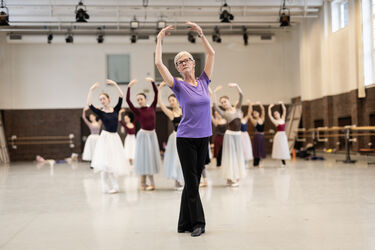
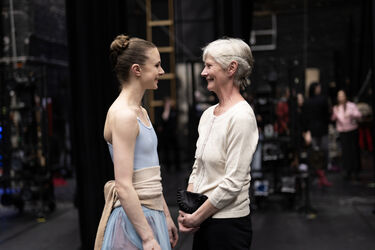
FAST FORWARDFor Judith Fugate, George Balanchine’s ballets are not simply historical repertoire — they are living works of art. Fugate first encountered George Balanchine and his world when she was just eight years old and started studying at the School of American Ballet. Later she became one of the leading principal dancers of the company Balanchine founded: New York City Ballet. Over several decades she worked closely with “Mr. B.” and gained a deep understanding of his musical and stylistic language. Today, as she stages his works for companies around the world, her task is to pass on not only the choreography, but also the artistic principles behind it.
© ×
c) Kiran West
© ×
c) Kiran West
© ×
c) Kiran West
Music, she explains, was always the starting point for Balanchine. Before rehearsals began, he would have the pianist play the score in full so that dancers could absorb the musical structure. “The dancers have to listen to the music,” Fugate says. “Not just count.” Balanchine often played with musical phrasing in unexpected ways: an eight-count might not be a simple four–four division but rather structured as three–three–two. For dancers accustomed to regular patterns, this can be challenging at first. Yet for Balanchine, movement should reflect the musical line itself — stretching and flowing like the arcs of a string melody.
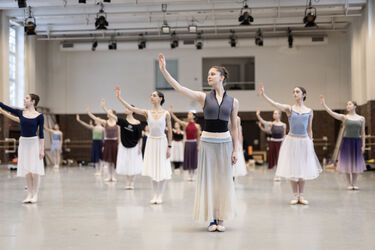
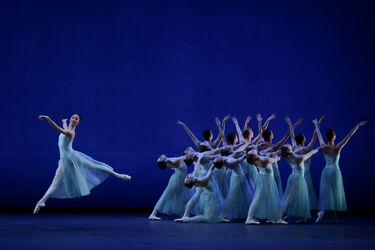
Serenade, created in 1934 for students at the newly founded School of American Ballet, also contains an element of spontaneity rooted in its origins. In early rehearsals, the number of dancers present would change constantly, depending on their availability — sometimes it was 17 girls, sometimes only four, sometimes a dancer arrived late, quickly joining the group to blend in. These circumstances shaped the ballet’s famous patterns and entrances, which remain an essential visual element of the work, still recognizable today.
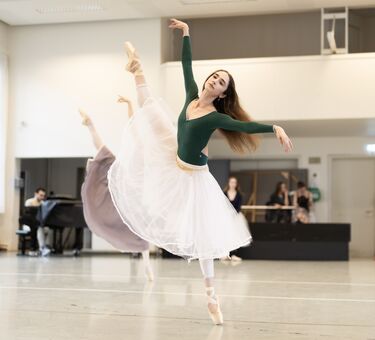
When Fugate stages Serenade, one of the main challenges is guiding dancers toward Balanchine’s distinctive movement quality. Small details make a significant difference: for example, the placement of the arms in an arabesque, the flow of the port de bras, or how the upper body moves through space. Sometimes a simple, relatable image can help shift a habit that dancers have learned since their first ballet class. For example, to achieve the right arm pathway, Fugate suggests imagining taking a T-shirt off over the head.
Today’s dancers are technically stronger than ever, she observes. The challenge is ensuring that this ability serves the ballet rather than overshadowing it. “We don’t want it to become flashy,” she says. “It’s more than technique — it’s finesse.” At the same time, she enjoys and values that the dancers are eager and curious: “They are hungry to learn,” she says, adding that it is exciting to see them embrace Balanchine’s style.
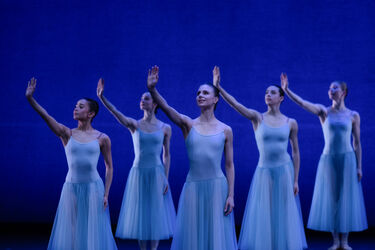
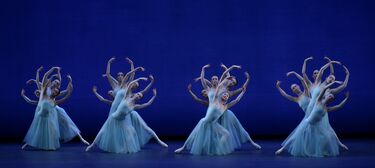
For audiences new to Balanchine, Fugate recommends watching how the ballet’s patterns and formations evolve across the stage — especially the sense of movement created by dancers entering, leaving, and reshaping the space. Already from the very first moment, when the curtain rises, seventeen dancers are carefully arranged on stage, forming the first striking image. It is also worth remembering that the ballet was originally created mainly for women: in 1934 there simply were not that many male dancers available.
© ×
c) Kiran West
© ×
c) Kiran West
© ×
c) Kiran West
Among Fugate’s favorite moments is the first movement, particularly an image created when the dancers form a diagonal line and perform a canon of sweeping “windmill” arms. An effect that, until today, takes her breath away.
As the opening work of a diverse mixed bill, Fugate sees Serenade as bringing a distinctive atmosphere to the evening. The ballet for her feels almost wind-swept: dancers rush in, cross the stage, disappear again, and reappear in new formations. Everything moves quickly, yet remains airy and light — and above all, passionate.
For Fugate, one of the most rewarding moments comes at the end of the rehearsal process: it is when dancers realize what they have achieved. Mastering Balanchine’s speed, musicality, and movement quality requires pushing beyond familiar habits. “When they feel they’ve accomplished that,” she says, “it’s a wonderful thing.”
© ×
c) Kiran West
Thursday
Thu
25.6.
-
Thu 25.6.26 19:30Main StageBallet51st Hamburg Ballet DaysFAST FORWARDBalanchine / Morau / Preljocaj / Xie
- Introduction 45 minutes before the performance
-
SerenadeGeorge Balanchine
-
TotentanzMarcos Morau
-
AnnonciationAngelin Preljocaj
-
The Moon in the OceanXie Xin
With: Katharina Müllner, Hamburg Ballett, Philharmonisches Staatsorchester Hamburg